
Nakedness
‘And when they had crucified him, they divided his garments among them by casting lots.’

Running up to Easter weekend I am publishing four reflections on the cross. Most were written a few years ago. Here’s the second of the four.
As a child I had an aptitude for drawing and painting and so, as I grew up, art played an important part of my life, starting in those early childhood years. I’d always chose drawing and painting or even making things over reading and writing. I remain indebted to my parents who saw some raw talent and so became great champions of my artistic leaning. It was therefore no surprise that when choosing my ‘A’ Level subjects, art featured as an obvious choice. Disturbingly for me, as a non-writer, part of the ‘A’ Level art syllabus included art history and this meant writing - a skill that, at the time, was unnatural to me -partly because of my using every spare moment I had to feed my obsession about all things artistic! Though my essays never made an A grade, the art history part of the syllabus helped me in understanding the importance of art and its place in the world – an enriching experience. Having just come to faith, religious art, in particular that which portrayed the Christian faith, attracted my interest. I recall the day we discussed a painting by a 16th century artist, whose name I can’t remember - a painting of the crucifixion. No surprise I can hear you say to yourself! Correct - the birth, life, death and resurrection of Christ featured extremely prominently in art throughout the Middle Ages and well beyond. However, this painting stood out from the vast majority of artists’ depictions of the Christ being crucified. Why? He was fully naked! No strategic loin cloth covering His naughty bits! When the painting was exhibited it was met with outrage. One visitor to the gallery was so enraged by the insensitivity of the handling of the subject that they lifted the painting from the wall, turned it around and re-hung the painting, picture facing the wall.
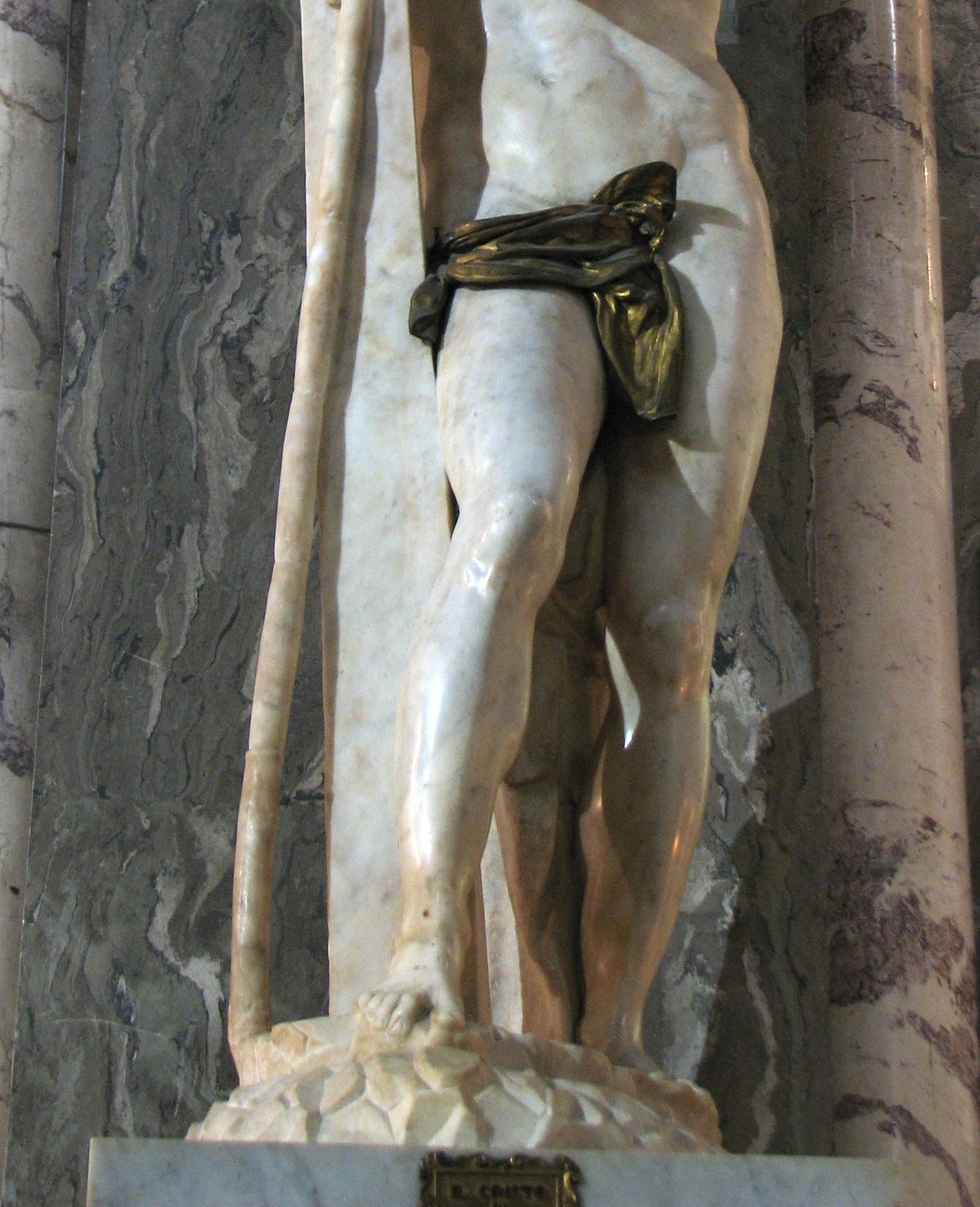
Michelangelo’s statue ‘The Risen Christ’, a masterpiece created in his middle years when he was 46, equally caused a stir when the commission was completed in 1521. It stands in the church Santa Maria Sopra Minerva in Rome. The risen Jesus stands triumphantly, leaning on an empty cross, totally naked! - similar in execution to the statue of David, yet in some ways more startling than his youthful David. After all, it is one thing to portray a young war-like hero naked, in the ancient Greek style, as the young Michelangelo did when he carved David, it is quite another thing to make a stark-naked statue of Jesus to go in a church. Unfortunately, if you visit this statue in Rome, you won’t quite see everything. After Michelangelo’s death, it was given a bizarre baroque metal veil to cover his private parts. This fig leaf like accessory is still in place. Why does Michelangelo depict the risen Christ naked? Maybe he wanted to reflect the fully human risen Jesus! Christ, having triumphed over sin and death, stands victorious as the new Adam, an Adam without shame! Who knows?
For some, the baroque veil covering Christ’s genitals and the turning of the painting of naked crucified Christ to face the wall, are appropriate steps to afford some dignity and respect to their Saviour. I am sure these acts of reverence and respect will strike a chord in many of our hearts. We too may have been moved to action in the light of Christ’s dignity being compromised. However, I wonder if we have to ask ourselves if these seemingly righteous actions are doing our Saviour an injustice? Are these acts of veneration and reverence, or is it the truth that we have a deep sense of awkwardness and unease about this naked Jesus? In our disquiet and discomfort at the sight of the naked Christ, whose nakedness and shame are we truly trying to cover? Why are we so uneasy, even anxious, about the portrayal of a naked Christ?
It’s worth saying at this point that I understand that the subject of whether Jesus was hung naked on the cross or whether he was afforded some respect and allowed to wear a form of loin covering, has been hotly debated over many years. History tells us that Roman execution was unspeakably horrific. Crucifixion, performed naked and in public and inflicting prolonged pain on the victim, was intended to cause shame as well as death. Both historic and contemporary writings that describe the crucifixion, state that the victim was naked as he was hanging on the cross. It seems clear then, that a Roman crucifixion involved stripping the transgressor totally naked.
In order for us to more fully explore what is potentially behind our well-intentioned acts of veneration, let’s turn to the book of Genesis. The Genesis account of the temptation of Adam and Eve may help us to understand the origin of humankind’s preoccupation with baroque veils! The first consequence of Adam’s and Eve’s sin mentioned in Genesis 3:7 is that “the eyes of both were opened, and they knew that they were naked. And they sewed fig leaves together and made themselves loincloths.”
Suddenly they are self-conscious about their bodies. Before their rebellion against God, there was no shame. “The man and his wife were both naked and were not ashamed” (Genesis 2:25). Now, there is shame. Why? Because the foundational covenant keeping love between them and God had collapsed. By believing a lie and in eating the forbidden fruit, Adam and Eve exchanged God’s government of their lives, and the security and peace that provided, for self-government. The Glory of God that covered their nakedness was lost and with it came shame, fear and insecurity. Shame attests to the absence of the Glory of God. In this act, both man and woman displace their Creator from His centrality and they become the centre, the core of their own world – selfishness is born. The kingdom of self is chosen over the Kingdom of God. This results in a deep sense of guilt, of being disfigured, degraded and the consequential sense of being unworthy. John Piper says; “Before the Fall, what was and what ought to have been were the same. But now, what is and what ought to be, are not the same”. Shame covers the gap between the truth of who I am now and the truth of who I ought to be.
Genesis 3:7 tells us Adam and Eve take a similar approach to the Catholic clergy of the 16th century with their baroque metal veil: ‘They sewed fig leaves together and made themselves loincloths.’ This is their endeavour to cover the gap between who they were and who they ought to be. The vulnerability they feel about their nakedness demands that they cover up. In effect, they are trying to present themselves in a way that is acceptable both to each other and to God. And of course, later we read that they fall into the grip of fear and in vain they attempt to hide from God. Shame inevitably leads us to hide.
All of us can identify to a greater or lesser extent with Adam and Eve, that we too attempt to manage the gap that exits between who we know we are and who we know we ought to be, in a wide range of ways. The thought that we might be less than we imagined ourselves to be, or less than others imagined us to be, leaves us feeling vulnerable and at risk. Often we find ourselves increasingly unwilling to face the truth about ourselves, which in turn leads us to find ways of covering up our profound internal sense of nakedness. Fearing what others may think of us leads us to manage the public face of our life or ministry. Sadly, the consequence of denying the truth leads us into self-deception. Though we once knew that this gap existed, now we have become proficient at hiding behind our own well engineered baroque veils.
In giving way to lust, King David sleeps with Bathsheba and she finds herself pregnant. Fearing that news will get out concerning his illicit affair and the loss of face that will follow as a consequence, he sets in place a cunning and manipulative strategy to cover up. King David knows there is a gap between who he is and who he knows he ought to be and so he engineers a complex veil of deceit to cover his shame.
Like King David, and often without realising it, in our haste to manage our public persona, we too cover up - we choose to live in pretence - we pretend things are OK when in fact they are often far from OK. As with Adam and Eve, believing a lie leads us to be deceived, but this deception has more momentum than we might imagine. The final destination of believing a lie and being deceived is self-deception, therefore we deceive ourselves.
Our deep sense of awkwardness about our nakedness not only causes us to look for ways of covering up but also leads us to hide. ‘They heard the sounds of the Lord God walking in the garden in the cool of the day and man and his wife hid themselves from the presence of the Lord God among the trees of the garden. Gen 3:8. The realisation of shame, the gap that existed between who they were and who they knew they ought to be, not only leads them to cover their nakedness but also creates insecurity, anxiety and fear. In order to manage their consequent emotional condition of insecurity, anxiety and fear, they look for a place to hide. They disconnect from the reality of their condition by trying to lose themselves in creation itself, by hiding themselves among the trees of the garden (v3:8). The material world became a place in which Adam and Eve sought refuge. Shame leads us not only to cover up, but often results in us seeking refuge in the material world. Consumerism, one of the virulent plagues of a post-modern world, can be defined as the preoccupation with, and inclination towards, material gain -
to acquire more ‘stuff’; normally driven by an underlying belief that this is the pathway to happiness. I wonder if this insatiable appetite of our post-modern age for more, bigger and better is symptomatic of the true condition of a world burdened by shame. Perhaps it’s shame that is feeding the decline in mental health among the younger generation. Perhaps the emotional, psychological plague that is on the rampage among young people, is in part fuelled by distorted ideals about who they should be. In realising that these are often unattainable dreams and goals, it results in them living, as Adam and Eve did, in a world of anxiety, insecurity and fear and maybe the carrier of this virus that has caused this plague, is the various addictive social media platforms that exist.
The final destination of our descending the slippery slope of covering up and hiding is denial. Adam and Eve’s final attempt to deal with shame, the gap between who they knew they were and who they knew they ought to be was denial. Listen to what they say when the Lord comes to find them, ‘ The man said. “The woman whom you gave to be with me, she gave me from the tree and I ate” Then the Lord God said to the woman, “What is this that you have done?” And the woman said, “The serpent deceived me and I ate” Gen 3:12. Though they know the truth, they know that who they are and who they ought to be are different, and that a gap exists - they choose to deny the truth and deceive themselves by making the declaration that their condition is not their responsibility - they blame someone else. Shame leads us to deny the truth about ourselves, blame others and adopt a victim mentality. Blame is often directed towards God, as we read in Adam’s response. Denial is a human condition, the cause of which is our election to govern our own lives. The denial of truth, blaming others, a ‘victim’ mindset and anger towards God, all feature in our post-modern world.
We are grateful that, by the mercy of God, we know the story doesn’t end here. God rejects our attempts to clothe ourselves, just as He rejected Adam and Eve’s attempts to clothe themselves. Christ’s death is foreshadowed in the shedding of blood to provide a covering for Adam and Eve. (3:21) In His love and mercy He clothes their nakedness. So too, with us, in His love and mercy, He clothes us through the shedding of the blood of Christ. How does He do this?
At the Cross of Calvary the shame that’s occupied the gap between who we know we are and who we know we ought to be, the shame that has held the entire human race tight in its grip, whether those who have lived, are living, or will live, is nailed to the cross. The dark powers of shaming that have drawn, do draw, and will draw humankind into their darkest shadows are defeated by the shedding of His blood. The tide of insecurity, anxiety and fear that follow in the wake of shame, that gap between who we know we are and who we ought to be, is stemmed at the cross. How is all this achieved? The shame that you, I and countless others know so well, is subsumed by Christ at Calvary. God is made naked! The veil is pulled back. God, in an eternal history making moment, acts with indescribable selflessness. One who knows no shame is shamed and in doing so, defeats its dehumanising power. In this act, shame is absorbed by love. He bridges the gap between who we are and who we know we ought to be.
Can I suggest that it is the spiritual discipline of confession that becomes the means by which we appropriate the absorption of shame by love. John in his epistle encourages us to ‘walk in the light as He is in the light’ - this is the place of real human connection. He describes this as ‘we have fellowship one with another’. To have true human connection we must walk in the light with one another. How is this achieved? In this act of walking in the light, ‘the blood of Jesus Christ cleanses us from all sin’. Our confession becomes a refusal to hide in the shadows and allow shame’s power to hold us in its grip. In confession we narrow the gap that exists between who we are and who we ought to be.
Reflection
1: If confession does appropriate the power of the cross to deal with the gap between who I am and who I know I ought to be do you have a friend with whom you can be completely honest and live in the light of reality? Develop a practice of confession.
2: We live in a culture of blame and ‘victimhood’. If the story of Genesis that we have read is right, blame is often the result of shame. ‘Victimhood’ is also part of the narrative. Take some time to reflect on whether you are prone to blame or seeing yourself wrongly as a victim.