
REST
Sabbath as an act of resistence

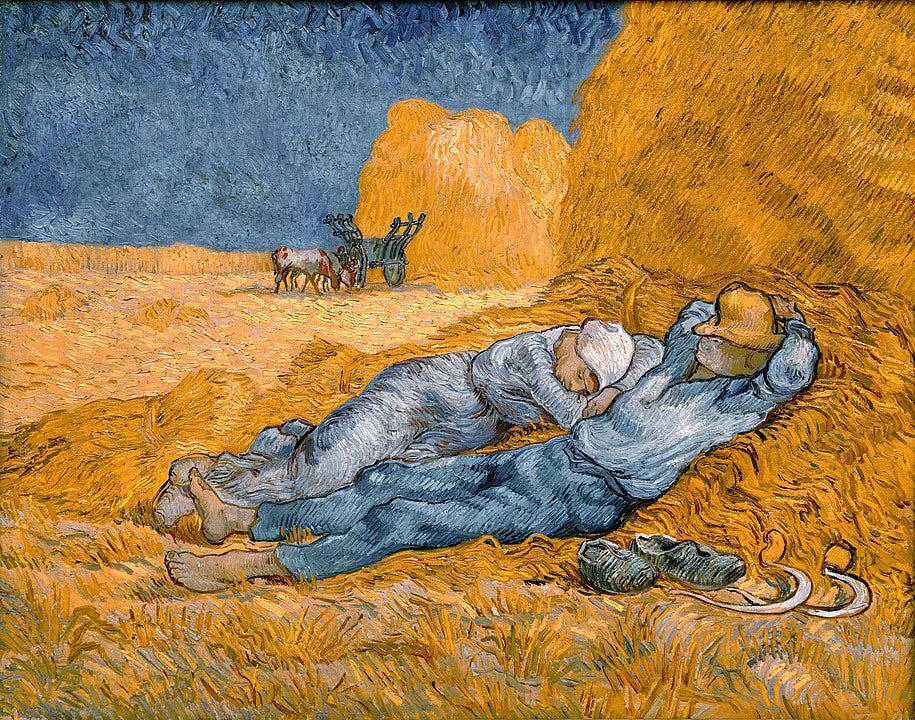
‘Six days a week we wrestle with the world, wringing profit from the earth; on the Sabbath we especially care for the seed of eternity planted in our soul.’ (Abraham Joshua Heschel – The Sabbath)
My proposition in this collection of essays, that we are all in some way or other subject to the power, control and influence of Mammon, is one thing; offering a proposition of how we could live free from the domination of the Mammonic narrative is something quite different. It requires what the late Walter Brueggemann calls ‘prophetic imagination’—a God-given vision of an alternate reality to that which we see unfolding in the prevailing culture. He was right! However, the truth is that, at best, we are spellbound by the rewards Mammon promises, and at worst, we are slavishly labouring on Mammon’s treadmill without even knowing it. And so, it does indeed require divine imagination to begin to conceive of a life liberated from its stranglehold.
The good news is that the gospel inspires prophetic imagining and vision. It makes a way for us all to break free from the power of the ‘machine’, the god called Mammon. The declaration of Christ at the cross that “It is finished” lies at the heart of the gospel. The dehumanising and predatory powers of sin, along with the accompanying forces of darkness that enslave you, me, and the whole of creation, were defeated by the holy, self-sacrificing love of Christ at Calvary. Now, as the apostle Paul says, we need to reckon ourselves dead to the ‘machine’, those predatory powers that seek to enslave us again, and alive to Christ. Emancipated from the tyranny of consumerism’s liturgy, individualism’s mastery, and secularism’s unbelief, we seek the peace and prosperity of our neighbourhoods, cities, and nation.
So, what does this look like in practice? This is an important question. James, in his letter, tells us that, ‘Faith by itself, if it does not have works, is dead.’ (James 2:17). He alludes to a new form of labour (work), inspired and reimagined by the very faith we have in the labour (work) of the crucified Christ. What I hope to do in between my articles on Mammon is suggest that there are some practices and rhythms that enable us to take a stand and resist the powerful tide of Mammon and its plundering nature. Perhaps they might serve as the kind of works that James was describing. I begin, in this essay, with rest.
Sabbath Rest
For many believers, shops shutting on Sundays and religiously observing an outright ban on anything that looked remotely like work on this ‘holy day’ are, at best, a distant memory; for others, it may come as a complete revelation that anything like this may have ever been considered normal! I recall that in the early years of my pursuit of following Jesus, it felt like a sin to visit a shop or watch television on a Sunday. Not only that, but it also felt that doubt would have been cast on whether my allegiance to Jesus was really true! How times have changed. Sundays are pretty much exactly the same as any other day of the week. Every day looks and, in many ways, feels the same.
Whilst I am not an advocate of blindly or vainly observing religious tradition, I wonder if, by jettisoning a well-established rhythm of rest, we are left with a bath minus an essential—the baby!
In recent years, I have had the great joy of taking time to read much more about the Sabbath. As a consequence, I am increasingly convinced that the faceless powers of acquisitiveness, productivity, and personal profit, to name but a few, have taken control of us and our diaries. Our resultant inability to stop leads us to descend back into chaos, and this is apparent in our ever-increasing over-extendedness, fatigue, anxiety, and fear. I think it’s time for change. It’s time to go back in order to move forward. We need to find that baby.
So, in this article, I want to delve a little deeper into the subject of Sabbath. In a sense, Sabbath gives us back control of time. Remember, in emancipating Israel, God takes time out of the hands of the Egyptians and gives it back to His people. May we too enjoy this great gift of freedom.
God creates ‘Sabbath’
And on the seventh day God finished all his work that he had done, and he rested on the seventh day from all his work that he had done. Gen 2:2 ESV
The words ‘and on the seventh day God finished all his work’ may be puzzling. Surely in six days the Lord made the heavens and the earth, and He rested on the seventh? (Exodus 20:11). We would expect this verse to tell us that God finished His work on the sixth day, but ancient rabbinic tradition concluded that a final act of creation took place on the seventh.
Genesis is the account of God’s astonishing handiwork, His giving shape and substance to all things by the power of His word. Heaven and earth were created in six days, and then on the seventh day, in a further act of creation, God brings His work to completion. How? On the seventh day, in His stopping, God creates Sabbath—menuha, meaning ‘rest’ or ‘ease’. The word here means much more than the withdrawal from labour, more than freedom from strain or activity of any kind. Menuha is not a negative concept, but something real and very positive. More accurately translated as joyous repose, tranquillity, peace, and harmony, in later times, menuha became a synonym for life in the world to come—for eternal life. God did not rest in the sense of taking a nap or chilling out; Sabbath is not just a day off—it is a state of being. After six days, what did the universe still lack? Menuha. God crafts the Sabbath, and the universe was complete.
For true rest to exist, it needs to be created. Sabbath is not an afterthought; it is not a break in the grind of expended effort and hard work. Sabbath is wholly and intrinsically a part of the world that God made for us to enjoy and delight in, just as He did on the seventh day.
God consecrates Sabbath
‘And God blessed the seventh day and made it holy’ Gen 2:3
One of the most legendary words in the Bible is the word holy—in many ways, a word which, more than any other, is archetypal of the mystery and the majesty of God. To what or to whom does God first attribute this quality? We might imagine it to be a mountain on which He appeared, an altar, or even a building of some description. Or we might expect its first reference to be to God Himself. No!
It is in the book of Genesis, as we read the story of God’s completion of creation, that we find the first use of this word. And it is noteworthy that it is used not in relation to things, but in relation to time. “And God blessed the seventh day and made it holy.”
At the dawn of creation, there was only one holiness in the universe: holiness in time.
The idea of holy (kadosh) implies differentiation; the realm of the holy is completely set apart from the common, habitual, and the secular. It means to be unique, distinct, consecrated, and sacred. In other words, the Sabbath is a sanctuary in time. It is not by chance that the commandment to keep the Sabbath is repeated immediately following the instructions for the building of the Tabernacle in Exodus (Ex. 31:13–17). Just as God’s sanctuary in space needed clear boundaries (a courtyard surrounded by a fence) to keep the realm of holiness separate from the common, so the Sabbath, as a sanctuary in time, requires clear boundaries to separate it from the other six days of the week.
Before I had the great joy of visiting Israel and meeting Jewish people, I was convinced that Orthodox Jewish observance of the Sabbath came with countless burdensome regulations that often amounted to little more than religious compulsion and compliance. To my surprise, I discovered that in the majority of cases this was simply not true. Honouring the boundaries that protect the sanctity of the Sabbath from the daily routine of the working week, and from the invasive nature of many associated activities, brought great freedom and peace to them and their families. The Sabbath releases the observant Jew from obligations such as checking emails, cleaning the house, mowing the lawn, taking the kids to various clubs and activities, or watching favourite TV programmes. Conversations are not interrupted by phone calls or texts; the temptation to shop is resisted. Religious compulsions? Maybe not. Is there something that we can all learn here?
God is the architect of both work and rest
8 “Remember the Sabbath day, to keep it holy. 9 Six days you shall labour, and do all your work, 10 but the seventh day is a Sabbath to the Lord your God. On it you shall not do any work, you, or your son, or your daughter, your male servant, or your female servant, or your livestock, or the sojourner who is within your gates. 11 For in six days the Lord made heaven and earth, the sea, and all that is in them, and rested on the seventh day. Therefore, the Lord blessed the Sabbath day and made it holy. (Exodus 20:8-11)
Rest is a sequel to work. “Six days you shall labour, and do all your work, but the seventh day is a Sabbath…”. We are designed for work, and we are also designed for menuha—rest. Exodus 20 ties the observance of both work and Sabbath to God’s creation. The duty to work for six days is as much a part of our participation in creation as the obligation for us to rest. Humankind, in Adam and Eve, is invited to work together for the sake of creation, “…to cultivate it and keep it…” (Gen. 2:15). God created us to work and the Bible warns us about the consequences of our neglect or failure to follow this blueprint (Prov. 10:3; 2 Thess. 3:10–12).
But that is not the complete picture. The Sabbath, as a day of withdrawing from work, is not a devaluation but an attestation of the worth of labour. Since God works, so do we; since God rests, we also must rest after our work. The rhythm of work and rest is for everyone, as part of our created nature. Both overwork and underwork violate that nature and so to rest is one of the ways we enjoy and declare both the goodness of God in His creation and in our own creation. To be faithful to how God has made us—how He has designed us—we must work but also rest. In sanctifying the Sabbath, we become imitators of God and celebrate His good design.
God designates Sabbath as a reminder of his redemption
12 “‘Observe the Sabbath day, to keep it holy, as the Lord your God commanded you. 13 Six days you shall labour and do all your work, 14 but the seventh day is a Sabbath to the Lord your God. On it you shall not do any work, you or your son or your daughter or your male servant or your female servant, or your ox or your donkey or any of your livestock, or the sojourner who is within your gates, that your male servant and your female servant may rest as well as you. 15 You shall remember that you were a slave in the land of Egypt, and the Lord your God brought you out from there with a mighty hand and an outstretched arm. Therefore, the Lord your God commanded you to keep the Sabbath day. (Deuteronomy 5:12-15)
Deuteronomy 5 tethers the observance of the Sabbath to God’s redemption of His people. Verse 15 says, “You shall remember that you were a slave in the land of Egypt, and the Lord brought you out from there with His mighty hand and outstretched arm.” Walter Brueggemann, in his great little book Sabbath as Resistance, makes the point that “prosperity breeds amnesia.” As Israel prospers, they must not forget God’s grace in redeeming them from the grip of slavery.
In bringing this great deliverance to mind, what must the people of Israel’s response be? How will they remember that God rescued them from their darkest days, living under the tyranny of Pharaoh in Egypt? The answer is the Sabbath: “Therefore, the Lord commanded you to keep the Sabbath day.” The Sabbath takes on a new meaning. God portrays the Sabbath day as a re-enactment of liberation from slavery. Keeping and protecting the boundaries of a day designated as holy, separate, and unique from all others becomes a means by which we remember and celebrate the unyoking nature of God’s redemptive work. It reminds us too how God liberated His people from a condition in which they had become dehumanised—they were simply units of capacity in Pharaoh’s manufacturing system. Implicit in the text is this: anyone who cannot observe God’s command to “Sabbath” is a slave, even if this is self-imposed.
Rest (Sabbath) reminds us of the fact that in Christ, God reached down and pulled us out of the consumerist mire. Through His atoning death, He has unfettered our souls from the endless pursuit of the “bigger,” “better,” and “greater.” Our stopping and resting raise a cry of thanks to God for reclaiming us from such degradation and declare that we are more than our work. Celebrate His saving power by taking a Sabbath.
Work = Worth = Identity - Sabbath subverts our culture
8 “Remember the Sabbath day, to keep it holy. 9 Six days you shall labour, and do all your work, 10 but the seventh day is a Sabbath to the Lord your God. On it you shall not do any work, you, or your son, or your daughter, your male servant, or your female servant, or your livestock, or the sojourner who is within your gates. 11 For in six days the Lord made heaven and earth, the sea, and all that is in them, and rested on the seventh day. Therefore, the Lord blessed the Sabbath day and made it holy. (Exodus 20:8-11)
Reading the opening pages of the Bible leaves us in no doubt that work was a part of paradise. One scholar summed this up so well: “It is perfectly clear that God’s good plan always included human beings working, more specifically, living in a cycle of work and rest” (Ben Worthington – Work: A Kingdom Perspective on Labour). God’s perfect design for you and me included the gift of work. Therefore, work is as much a basic human need as food, friendship, rest, prayer, and sexuality. You only need to speak to someone who has been made redundant or cannot work for some reason to realise that work is required in order for us to thrive emotionally, physically, and spiritually.
We must, however, take care. There is a powerfully deceptive inclination in the human heart to make work, and the resultant outcomes, the foundation on which we build our meaning and identity. Luther would say that when the primary purpose of work is distorted, it often becomes a means by which I seek to distinguish myself from my neighbour—to prove to myself and the world that I am unique or significant. Work becomes less an act of worship; instead, it becomes an object of worship. It’s about “me.” Work morphs into a totem, an idol that holds the affections of our hearts, and as a consequence, becomes the means by which we derive our whole sense of value and personhood.
In God’s instruction to His people to remember the Sabbath, God is drawing a line in the sand in respect of the difference between life as it was for them (in Egypt) and how it is now as free people. In Egypt, as Pharaoh’s slaves, the Israelites were brick makers. In this Pharaonic system, the work they did defined them. Work and worth were inextricably linked. Accomplishment was defined by productivity; if you could not make bricks, you were of no value to Pharaoh. You were, literally, what you produced. Ceasing from work was more than a stoppage of labour. Having been emancipated from their slavery in Egypt, by recovering the rhythm of Sabbath as designed by God and evidenced in creation, they substantiated the truth that their identity was not found in work. God was God and worked for six days, and though He rested on the seventh, He was still God. Just as His identity was not defined by work, His people would not be defined by their activity either.
One last thought: as we see from the passage in Exodus 20, Sabbath rest is equally applied to everyone: “…you shall not do any work, you, or your son, or your daughter, your male servant, or your female servant, or your livestock, or the sojourner….”. Sabbath establishes equality for all. Position, power, status, and influence count for nothing when it comes to the need and right for Sabbath.
One of the default settings of the Mammon-driven machine is relentless progress—an insatiable appetite for “ever better,” “even bigger,” and “much more.” The result is that many of us, consciously or unconsciously, find ourselves enslaved on its treadmill. Choosing Sabbath rest becomes an act of resistance—and a bold declaration of hope that there is bread that comes down from heaven.